
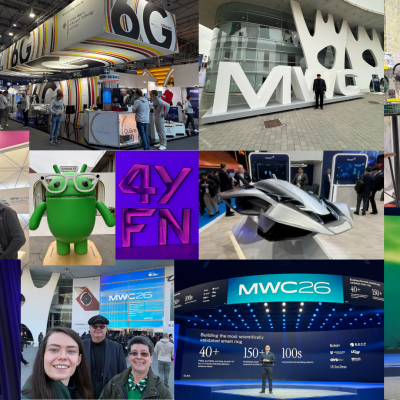
It has been a couple of weeks since this year’s MWC 2026 took place at the Fira in Barcelona. I have now had the time and distance to properly reflect on the event as well as hear from other attendees before sharing my own thoughts. I pride myself in being an observer of the industry with a specific focus on networks and Europe and hope my observations help you in your endeavours to learn and collaborate.
Trust
Telecom operators are the custodians of the digital world and have a responsibility to make sure that it is both usable and safe. There’s a fine line between authentic digital content and the virtual world, created both to impress and deceive. Operators have the obligation to use the power of their network to ensure that trust is maintained and put users in a position to decide and control what they trust or not. Andrew Collinson did a LinkedIn post with some good points on this.
Security
Security and trust go hand in hand, with security underpinning the efforts to establish and maintain trust. In the first keynote the speakers indicated how AI is now in the hands of fraudsters and scammers who are accelerating and generating new threats and stealing a march on the industry. As digital becomes a fabric of society, over the last years governments have seen the need to designate telecommunications as the critical infrastructure that it now is. In Europe we have the Telecom Security Act which has to be implemented in the various countries. Related to the security posture within operators this changes the emphasis from best effort to verified adherence to security standards. Germany is leading in this area with start-ups like Montsecure offering security compliance and verification services to governments, operators and vendors.
5G
Different geographies have different scale and are moving at different paces related to the role out of 5G and 5G plus. The following comments relate to Europe, which is my focus with other parts of the world being ahead and some behind.
This is the year of the delivery of REAL 5G. What I mean by real is having a 5G core connected to the RAN which is being rolled out across public networks. In addition, we see a growing appetite for mobile private networks based on 5G standalone to support a wide range of use cases which rely on the properties and features of 5G SA being adopted in preference to other connectivity technologies. In fact, in simple terms 5G standalone is the first technology which allows a 3GPP connectivity to guarantee and maintain a quality of service in relation to a moving device requiring low latency connectivity. The prime example being factories and robotics. At the GloMo Awards Cumucore won the award for “Best Digital Tech Breakthrough for Time Sensitive Network over 5G” with their unique 5G core designed specifically for industrial private 5G networks.
6G
The interest in 6G was distinctly underwhelming despite the efforts of interested parties to continue to announce they are 6G ready despite the standard not yet to being defined. With conservative efforts being that it will not be ready for deployment until 2030 at the earliest. Having said that, one use case which I’m not sure is dependent on any step change in functionality is sensing, which was an interesting topic at FYUZ 2025. Companies such as China Mobile have already achieved this with 5G plus which won an award at the ITU AI for Good Summit in summer 2025. I was privileged to have Lingli Deng from China Mobile Research on my podcast Digitel Talk to share their inspiring use case of 5G in marine conservation.
Footfall and attendance
Congratulations to the GSMA on putting together such a comprehensive and interesting event with an impressive number of 105,000 attendees. Having said that, within the conference centre the Fira the footfall seemed less than previous years which may be due to several factors.
Firstly, of course we cannot ignore the war in the Middle East which definitely had an negative impact on the overall numbers. One reliable source from one of the largest vendors mentioned that up to 25% of their staff were unable to make it due to the war. If you scale that up, that’s quite a large number of attendees unable to make it. On the other hand, the student fair which is held at Fira Barcelona will have boosted overall numbers. This event is in its second year but growing. An important addition as the industry does need to present itself to the next generation as an attractive workplace. A speculation from one of the analysts was that due to budget constraints the number of delegates from operators was down from previous years from 12% to closer to 7%. Those representing operators therefore are left to field an avalanche of requests from large vendors given the operator delegates limited free time to venture beyond Hall 3.
Changing the shape of the event
It is well publicised that the telecom market is shrinking in terms of employees but also consolidation, contraction and reduction in the number of network equipment vendors. Partly driven by the lack of ability to generate new revenues and the pressure to drive down costs and the fundamental necessity to adopt more efficient and effective working practises by using techniques through AI. Having said that, the number of companies involved in the wider digital economy and industry verticals demonstrating what they can do on top of connectivity is growing in numbers and importance. Leading to the whole event becoming more of a digital event underpinned by connectivity rather than being the telco focused event it once was.
AI
I continue to argue that the term AI is meaningless in itself and its origin can be traced back to being first coined in the 1950s by John McCarthy, in connection with the Dartmouth Summer Research Project in the 1950s. To be meaningful we need to define what type of AI you mean.
Generative AI
Generative AI is a technology we are all aware of due to the pervasive manner it is pushed to us by large corporates on our phones and desktop applications. In the IT area gathering and understanding contextual customer information is being successfully rolled out. This is where most operators are showcasing their capabilities that they have embraced AI. However, here telecoms are adopting and following the lead from other industries.
AI for networks
Machine learning has been a technique used within the telecom industry for more than 30 years and is used to detect patterns and monitor the network to derive next best actions. Given the fact that by design each AI prompt is unique, there are also inconsistent outputs which a user must verify. It is therefore not deterministic and unsuitable for the provisioning of the network, where precision, consistency and guaranteed resiliency are key. In this area autonomous networks are the holy grail, ideally without humans in the loop. Companies such as brown-iposs were demonstrating level 5 automation, which is in production for specific well defined RAN optimisation use cases which you can read more about here.
Networks for AI
Any network API or AI using network data is limited by the quality of the data in the underlying network. Operators have a deep and rich data set and over the last decades have wondered how this can be used and monetised within the regulatory environment. Focusing on the network the key ingredient to being able to extract value out of the network is establishing and maintaining consistent deterministic configuration of the network, using algorithms such as Inmanta do with their intent based network orchestration.
New voice – dusted off and now trending
As an example, Deutsche Telekom are reimagining phone calls by embedding AI in the network, with their premier of the Magent AI Call assistant which is available through normal calls and includes useful functions like translation, call summaries and contextual support, built in partnership with ElevenLabs.
Sovereignty
Given the political leadership of the United States and the war in Middle East we’re seeing a re-evaluation of longstanding relationships and partnerships. There are several layers and ways of interpreting sovereignty, but in its purest form, a country must be able to be self-sufficient and continue to function without the support of a third country. Given the integrated world we live in this will be difficult to achieve, but we are seeing that the shine is coming off hyper-scalers. In Europe in particular there is a political will to achieve self-sufficiency and ensure regional autonomy. This won’t happen overnight but is a clear direction of travel.
NTN
In the opening keynote, the CEO of Vodafone Margherita Della Valle conclusion was that although direct to device satellite connectivity is an exciting new frontier for telecoms, it is also the unregulated wild west. Given the comment about sovereignty, it remains important for enterprises and countries to be prudent regarding who they partner with as this is a long-term commitment. For example, in the war in Ukraine we’ve seen that switching off satellite links has literally lost the situational awareness of an army with an immediate negative impact. We also need to remain cognizant that satellite is a necessity, for connectivity to remote areas with only 10-20% of the worlds land surface having terrestrial coverage. Commercially the urban areas are of interest, but here due to the user density and capacity requirements, satellite soon becomes saturated not to mention the physical reality of indoor coverage. Despite the hype and the number of satellites being launched the capacity in the sky remains well under 1% of the capacity needed.
Quantum
Regarding both transport and security this article would be incomplete without mentioning quantum. The next frontier for compute is quantum and several of the operators had pilots and research work on their stands to demonstrate some of the potential capabilities including using photons to move data over distances in a secure manner.
Final MWC thoughts
MWC 2026 was a testament to the telecom industry’s transformation, showcasing its pivotal role in the broader digital ecosystem. From the tangible advancements in 5G and private networks to the cautious exploration of 6G, the event highlighted both progress and potential. Key themes like trust, security, AI integration, and sovereignty underscored the industry’s focus on innovation while navigating global challenges. Despite shifts in attendance and the evolving shape of the event, MWC remains a vital platform for collaboration, driving the future of connectivity and its impact on society. As the industry adapts to new realities, it’s clear that telecoms are not just keeping pace, they’re setting the stage for what’s next.